
SH.052-0
Ghazanchetsots St. Amenaprkich Cathedral
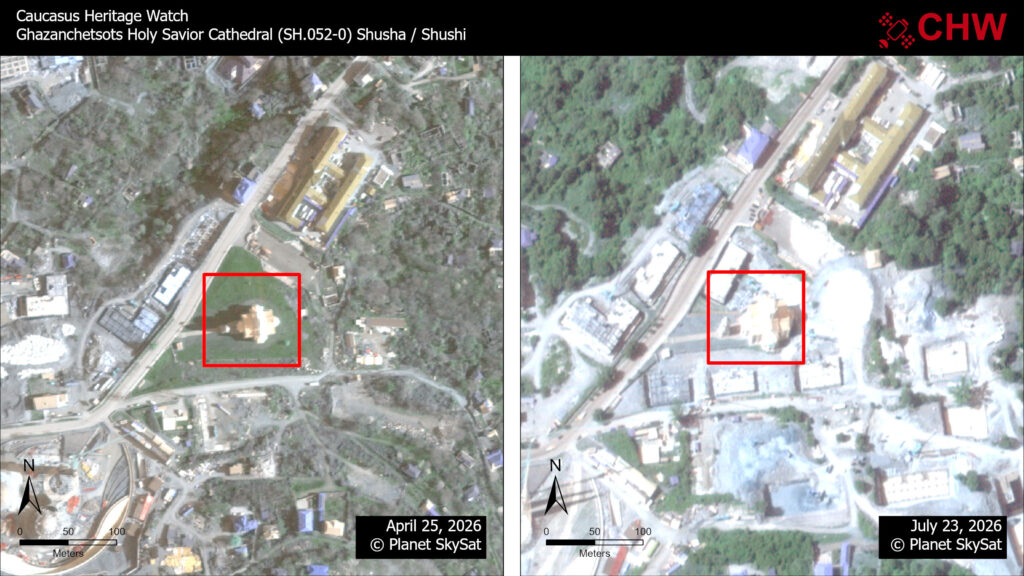
Before Image Date: April 25, 2026
Impact Image Date: July 23, 2026
Ghazanchetsots Cathedral in Shusha/Shushi was originally a wooden structure but was rebuilt in stone during the early 19th century. A standalone belfry was added to the site in 1858 and the cathedral itself was reconstructed in white limestone between 1868 and 1887. The 20th century history of the structure is closely tied up in the patterns of war and tragedy that have impacted the town as a whole. Most recently, Azerbaijan’s fiorces targeted the building during the 2020 war, leaving a shell hole in the southern roof (at right, top right, arrow A).
The surrounding grounds (arrow B) have been impacted in the years since, including the demolition of a carved stone in the yard documented by CHW in monitoring report #1 and the steady erasure of the ornate walkways. By April 25, 2026, the decorative walkways had been completely erased (at right, bottom left). And by July 23, 2026, a massive building program had commenced on the grounds with four visible new buildings rising and large debris heaps east and north of the cathedral (arrow C).
The British urban design firm, Chapman Taylor, has developed a master plan for Shusha that is advertised as respecting ” the historic street pattern.” But the masterplan appears to hide the cathedral behind blocks of flats, threatening the integrity and authenticity of the historic structure.